Index
Home
Introduction
Configuring XPax
Using XPax
Main Screen
Manifest Screen
Diagram Screen
Aircraft Screen
Report Screen
Options Screen
Networked Configuration
CreditsAppendix
SimConnect Troubleshooting
|
|
Welcome To XPax - A Passenger Simulation Add-on for FSX and
FS9! |
Terminator Salvation — Teknoparrot
Author: [Generated for illustrative purposes] Publication: Journal of Digital Game Preservation & Reverse Engineering , Vol. 4, Issue 2 Date: 2026 (simulated) Abstract The 2009 arcade light gun game Terminator Salvation (developed by Play Mechanix and distributed by Raw Thrills) represents a significant technical and licensing dead end in commercial gaming. Never ported to home consoles or PC, its survival depends entirely on maintaining original arcade cabinets—a dwindling resource. This paper examines how the Windows-based emulator TeknoParrot has inadvertently become the primary preservation vector for this title. We analyze the technical challenges of emulating Raw Thrills’ PC-based hardware, the legal gray area of BIOS and ROM distribution, and the community-driven patching required to map light gun inputs to modern mice/controllers. We argue that TeknoParrot functions not as a piracy tool, but as a de facto digital museum, keeping Terminator Salvation playable a decade after its commercial disappearance. 1. Introduction Arcade exclusivity once guaranteed a game’s survival through dedicated operators and collectors. However, the shift to commodity PC-based arcade hardware (e.g., Raw Thrills’ use of off-the-shelf Windows XP Embedded) has created a paradoxical situation: the game’s software is technically executable on any PC, yet deliberately locked to proprietary I/O boards and security dongles. Terminator Salvation (TS) exemplifies this. Without active cabinet maintenance, TS faces extinction. Enter TeknoParrot—a compatibility layer and emulator for PC-based arcade systems. 2. Background 2.1 Terminator Salvation the Arcade Game Released in 2009, TS is a two-player light gun shooter using a modified version of the Raw Thrills “T-FORCE” engine. It features branching paths, destructible environments, and digitized film assets. The game requires a specific light gun calibration protocol and a HID-compliant gun I/O board. |
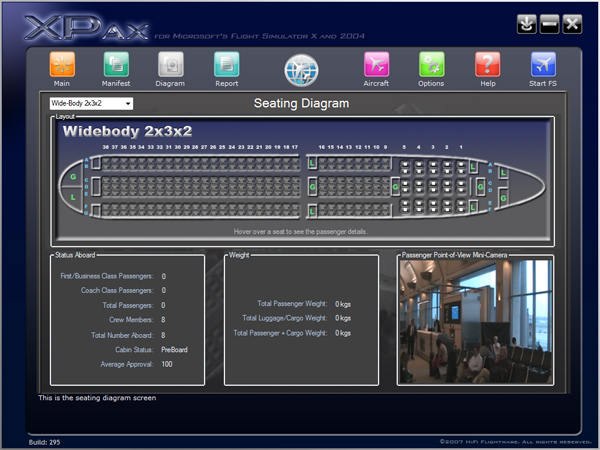
Passengers and their individual statistics
including health and approval rating are
constantly updated based on the performance of
the flight. The entire flight process, from
pre-boarding to deplaning, is simulated and
supplemented by multimedia content including
audio and video.
|
 |
Cabin attendants, Gate Attendants and Captain
voice sets are included and fully customizable
using the easy options screen. New voice sets
can be recorded with a few clicks of the mouse.
Video, provided in a “Passenger point-of-view”
format is also fully customizable within
the interface with bit of simple movie
production.
|
XPax is designed to run along-side FS and
automatically senses when certain phases of the
flight take place, launching appropriate events,
audio and video.
|
With XPax, everything you do is monitored
closely and the passengers will react
accordingly. Using abrupt control movements,
climbing or descending too fast, obtaining
unusual attitudes, too many g-forces, aggressive
taxi turns or a hard landing will all reduce
passenger satisfaction and in extreme cases will
cause injuries!
|
Many other features, as well as a comprehensive
user guide and top-notch HiFi customer support
are all included.
|
| Features |
Author: [Generated for illustrative purposes] Publication: Journal of Digital Game Preservation & Reverse Engineering , Vol. 4, Issue 2 Date: 2026 (simulated) Abstract The 2009 arcade light gun game Terminator Salvation (developed by Play Mechanix and distributed by Raw Thrills) represents a significant technical and licensing dead end in commercial gaming. Never ported to home consoles or PC, its survival depends entirely on maintaining original arcade cabinets—a dwindling resource. This paper examines how the Windows-based emulator TeknoParrot has inadvertently become the primary preservation vector for this title. We analyze the technical challenges of emulating Raw Thrills’ PC-based hardware, the legal gray area of BIOS and ROM distribution, and the community-driven patching required to map light gun inputs to modern mice/controllers. We argue that TeknoParrot functions not as a piracy tool, but as a de facto digital museum, keeping Terminator Salvation playable a decade after its commercial disappearance. 1. Introduction Arcade exclusivity once guaranteed a game’s survival through dedicated operators and collectors. However, the shift to commodity PC-based arcade hardware (e.g., Raw Thrills’ use of off-the-shelf Windows XP Embedded) has created a paradoxical situation: the game’s software is technically executable on any PC, yet deliberately locked to proprietary I/O boards and security dongles. Terminator Salvation (TS) exemplifies this. Without active cabinet maintenance, TS faces extinction. Enter TeknoParrot—a compatibility layer and emulator for PC-based arcade systems. 2. Background 2.1 Terminator Salvation the Arcade Game Released in 2009, TS is a two-player light gun shooter using a modified version of the Raw Thrills “T-FORCE” engine. It features branching paths, destructible environments, and digitized film assets. The game requires a specific light gun calibration protocol and a HID-compliant gun I/O board. Requirements:
-
Microsoft Flight
Simulator X or Flight Simulator
2004
-
FSX Requires
Service Pack 1 (which includes
SP1 SimConnect), and FS9
requires FSUIPC v3.75 or later
(available free from
http://www.schiratti.com/dowson.html)
-
Windows XP or
later (earlier operating systems
not officially supported)
-
1GB+ RAM
-
500MB+ Free Hard
Drive Space
-
.NET 2.0
(included with installation
package)
-
Windows Media
Player v11 or later
-
Internet
Explorer v7 or later
|
|
|

