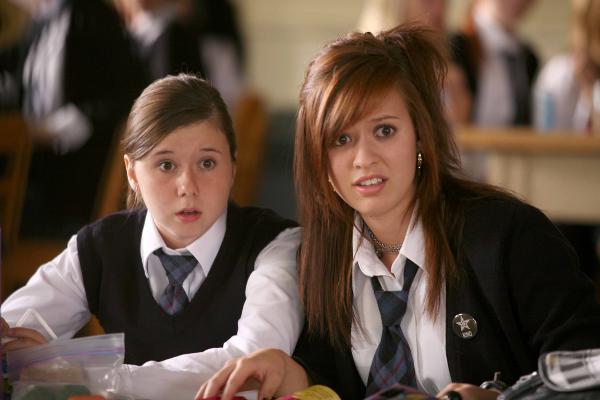
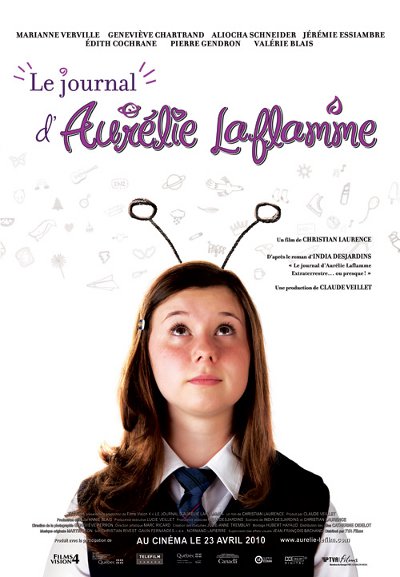
Journal d’Aurélie Laflamme, Le – Film de Christian Laurence

Le Journal d’Aurélie Laflamme est une comédie pour adolescents dont le personnage principal est tiré de la populaire série de livres écrits par l’auteure India Desjardins.

Le journal d’Aurélie Laflamme de Christian Laurence

Le journal d’Aurélie Laflamme de Christian Laurence

Le Journal d’Aurélie Laflamme est une comédie pour adolescents dont le personnage principal est tiré de la populaire série de livres écrits par l’auteure India Desjardins. Ce film est basé sur le premier tome de la série « Aurélie Laflamme, Extraterrestre ou presque ». Le réalisateur Christian Laurence vient du domaine de la télévision et signe ici son premier long-métrage de cinéma.

Comme on pouvait s’en douter d’après les succès obtenus par les livres, Le Journal d’Aurélie Laflamme fut reçu chaleureusement par le jeune public québécois qui en fit l’un des succès au box office de 2010. Au niveau international, le film de Christian Laurence eut droit à quelques sélections dans les festivals francophones, sans toutefois se démarquer outre mesure.

Un second film tiré des aventures d’Aurélie Laflamme a été produit par la suite.

Résumé

Aurélie est une adolescente de 14 ans, un peu perdue et donc en quête de solutions. Entre les habitudes de sa mère sédentaire et les chicanes avec sa meilleure amie, elle rêve à son premier french kiss ! Mais au fond, Aurélie se sent bien seule dans l'’univers, surtout depuis la mort de son père, il ya 5 ans.

Et si son père était simplement un extraterrestre, ayant quitté la Terre pour rejoindre sa planète? Génétique oblige, Aurélie serait elle-même une extraterrestre! Ceci expliquerait bien des choses. Par exemple, pourquoi elle se sent si différente des autres (surtout de sa mère), pourquoi elle n'’est pas capable d’'enligner deux mots sans faire une gaffe, et surtout pourquoi les garçons lui tapent vraiment sur les nerfs.

Synopsis officiel

Distribution

Marianne Verville (Aurélie Laflamme) ; Geneviève Chartrand (Kat) ; Aliocha Schneider (Nicolas) ; Jérémie Essiambre (Truch) ; Edith Cochrane (mère d’Aurélie) ; Pierre Gendron (Denis Beaulieu) ; Valérie Blais (Marie-Claude) ; Sylvie Potvin (Soeur Rose)

Fiche technique

Genre: Comédie dramatique - Origine: Québec, 2009 - Sortie en salles: 23 avril 2010 dans 83 salles au Québec - Durée: 1h48 - Classement: Général - Tournage: septembre-octobre 2009 - Budget approximatif: 4,1 M$

Réalisation : Christian Laurence - Scénario : Christian Laurence et India Desjardins, d'après le roman éponyme d'India Desjardins - Production : Claude Veillet et Lucie Veillet - Société de production : Films Vision 4 - Distribution : TVA Films

Équipe technique - Costumes : Julie-Anne Tremblay - Direction artistique : Marc Ricard - Montage : Hubert Hayaud - Musique : Martin Léon - Photographie : Geneviève Perron
The deep‑seated human impulse to watch —to experience stories of triumph and catastrophe—remains unchanged. The challenge for the global media economy lies in reconciling that impulse with a sustainable model that respects both creators and consumers, ensuring that future seismic events on the cinematic landscape are felt not as illicit tremors but as collaborative, equitable movements.

In the Indian context, platforms such as , Netflix , and Disney+ Hotstar now provide localized dubs and subtitles for many Hollywood releases, including San Andreas , thereby reducing the demand for third‑party sites. 5.3 The Role of Education Long‑term mitigation may hinge on digital literacy initiatives that explain the economic impact of piracy, promote respect for creators, and teach users how to navigate legitimate channels. Simultaneously, cultivating an understanding of fair use and public domain can demystify the legal nuances surrounding digital content. 6. Conclusion The seemingly innocuous query “San Andreas movie download Tamilyogi – Google” opens a window onto a complex ecosystem where cinematic spectacle, technological ingenuity, economic inequality, and cultural desire intersect. San Andreas itself, a film about humanity’s confrontation with an unstoppable natural force, mirrors the modern struggle between the unstoppable tide of digital piracy and the structural walls erected by copyright law.

Conversely, the —the belief that knowledge and art should be universally available—remains a potent counter‑argument, especially when legal alternatives are scarce or unaffordable. The ethical debate thus pivots on balancing rights (intellectual property) with needs (cultural consumption). 5. Policy Responses and Future Trajectories 5.1 Enforcement and Its Limits Governments have employed a mix of copyright injunctions , site blocking , and criminal prosecution to curb platforms like Tamilyogi. While these measures can disrupt operations temporarily, they often push piracy into more decentralized venues—peer‑to‑peer networks, private Discord servers, or blockchain‑based streaming—making enforcement more challenging. 5.2 Business Model Innovation Legal distributors have responded by lowering price points , expanding regional catalogs , and offering flexible payment options (e.g., micro‑transactions, ad‑supported free tiers). The rise of “transactional video‑on‑demand” (TVOD) models—where a user pays a small fee for a single rental—aims to compete directly with the convenience of piracy.

This duality creates a tension: while piracy undermines the financial model that enables high‑budget productions, it also serves as an informal distribution channel that respects linguistic and cultural preferences absent from official releases. Many users rationalize piracy through a “no‑harm‑done” narrative: “I’m not stealing a physical product; I’m just copying a digital file.” Yet this perception ignores the systemic impact on creators, technicians, and ancillary industries. In the case of San Andreas , the loss of potential revenue may affect future projects that employ thousands of crew members, stunt performers, and visual‑effects artists.

The film’s global box‑office success—grossing over $470 million worldwide—illustrates the universality of its premise. Yet its reception also highlights a paradox: while audiences crave the spectacle, the same viewers often encounter barriers to legitimate access, especially in regions where theatrical distribution is limited or price points are prohibitive. 2.1 From Peer‑to‑Peer to Streaming Aggregators Piracy has evolved from the early days of Napster and Kazaa to modern streaming aggregators that host massive libraries of copyrighted content. Tamilyogi epitomized a specific phase of this evolution: a centralized portal that aggregated links to third‑party video files (often hosted on services like Google Drive, Mega, or rapidshare) and presented them under a user‑friendly, language‑specific interface.

While the shutdown of Tamilyogi represents a victory for rights‑holders, it also signals a broader transformation: the migration of piracy to ever‑more resilient, decentralized platforms, and the simultaneous rise of legitimate services that strive to meet the same consumer expectations of speed, affordability, and linguistic relevance.