Related Resources
Take your learning further with these popular English study packs.
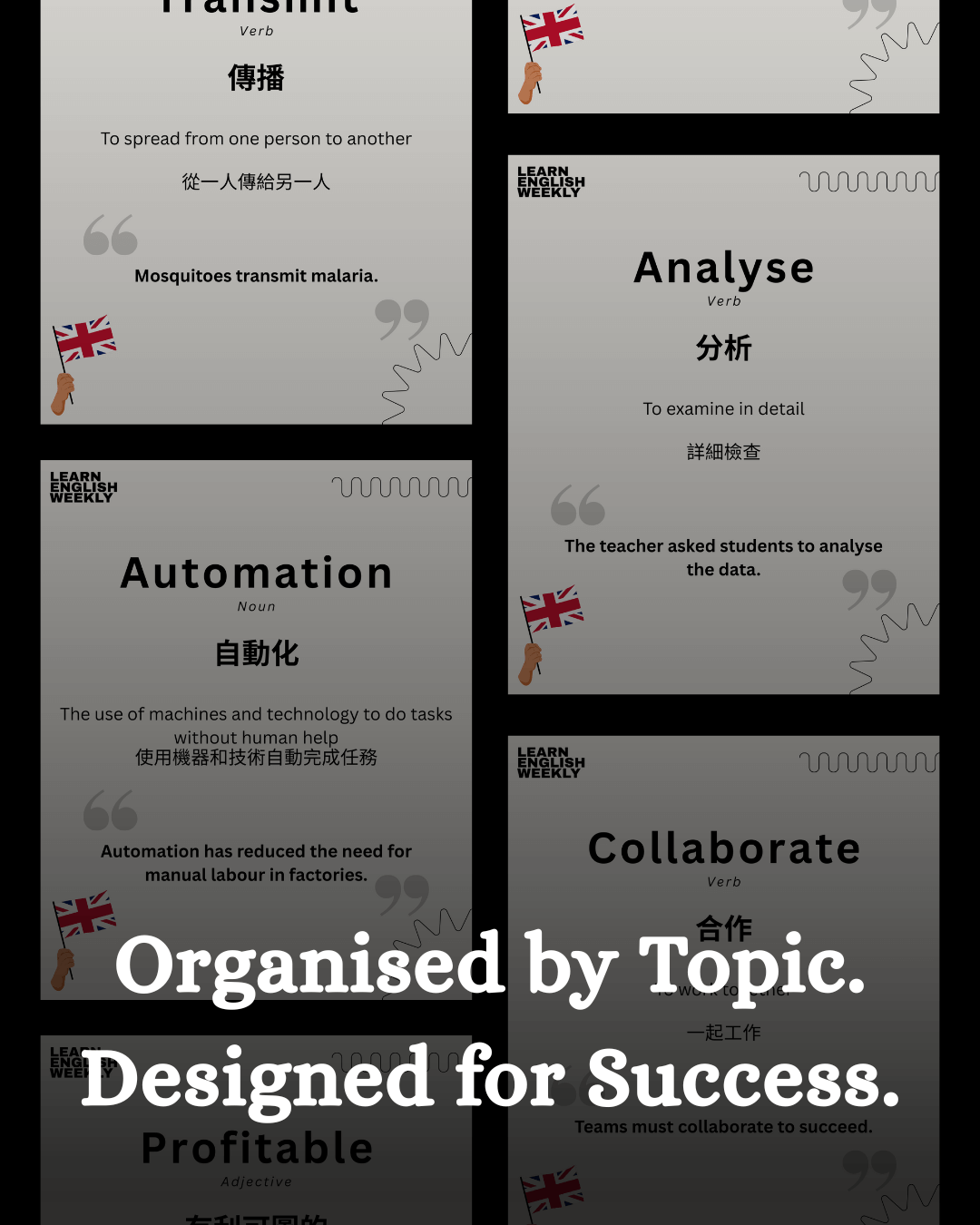
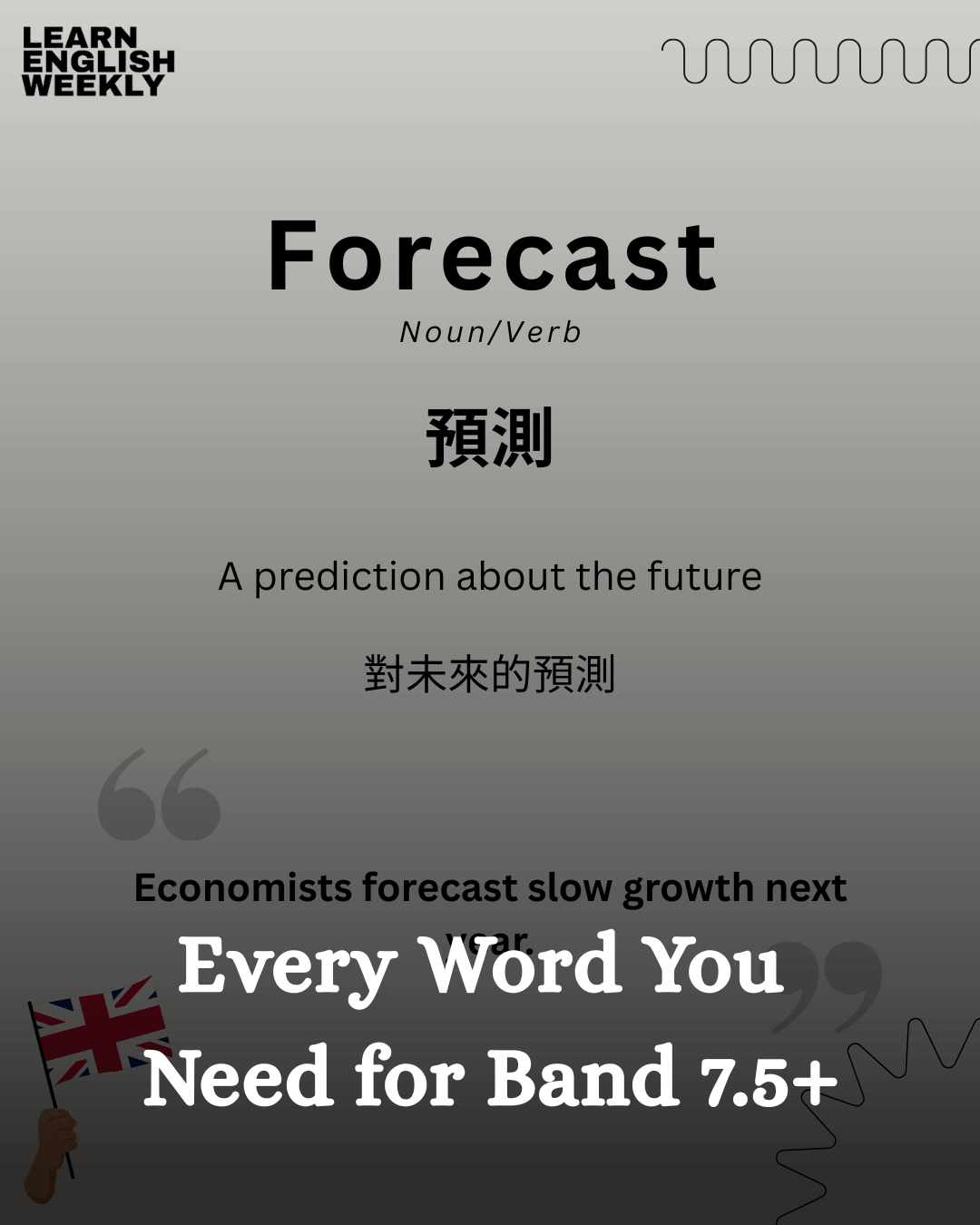
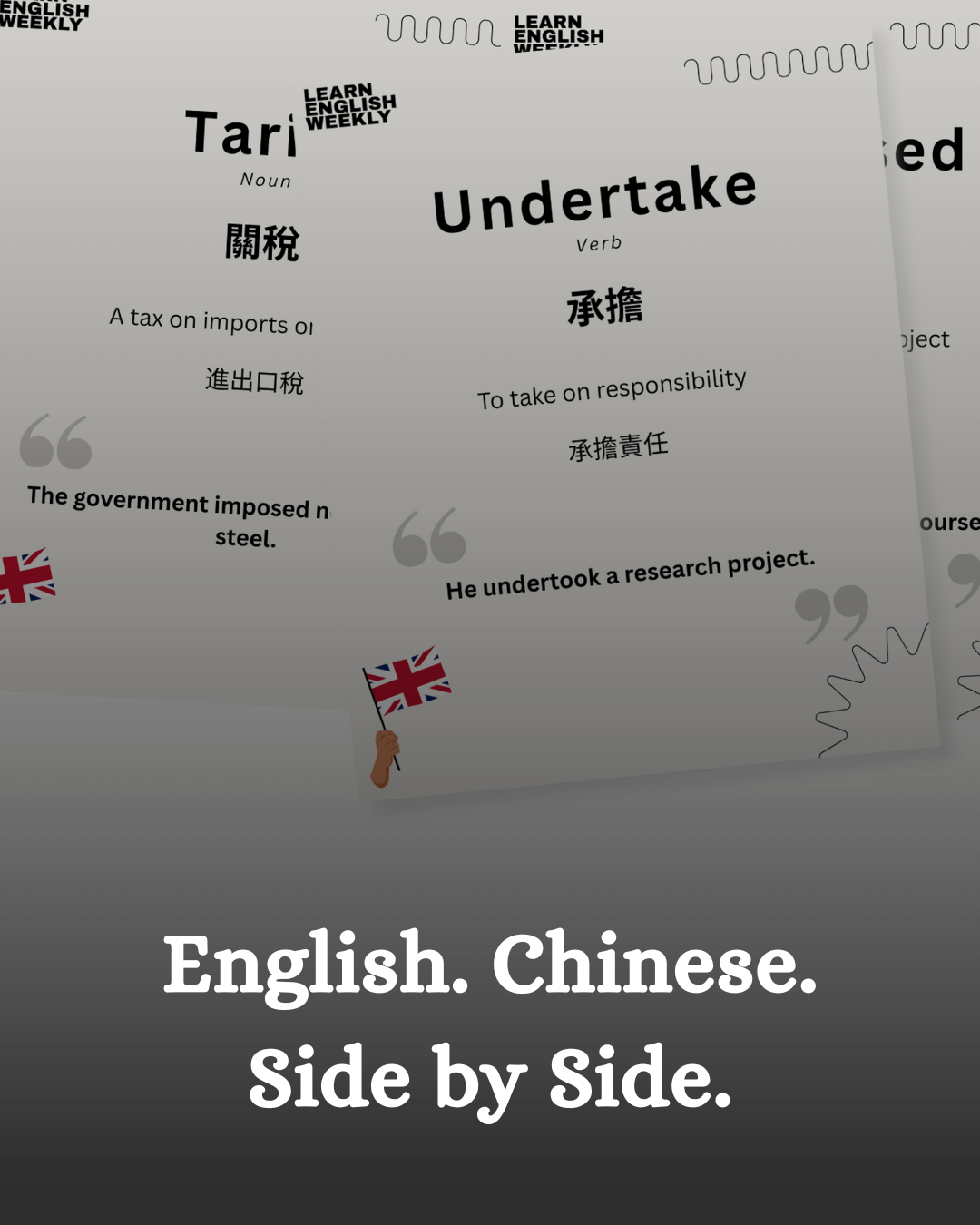
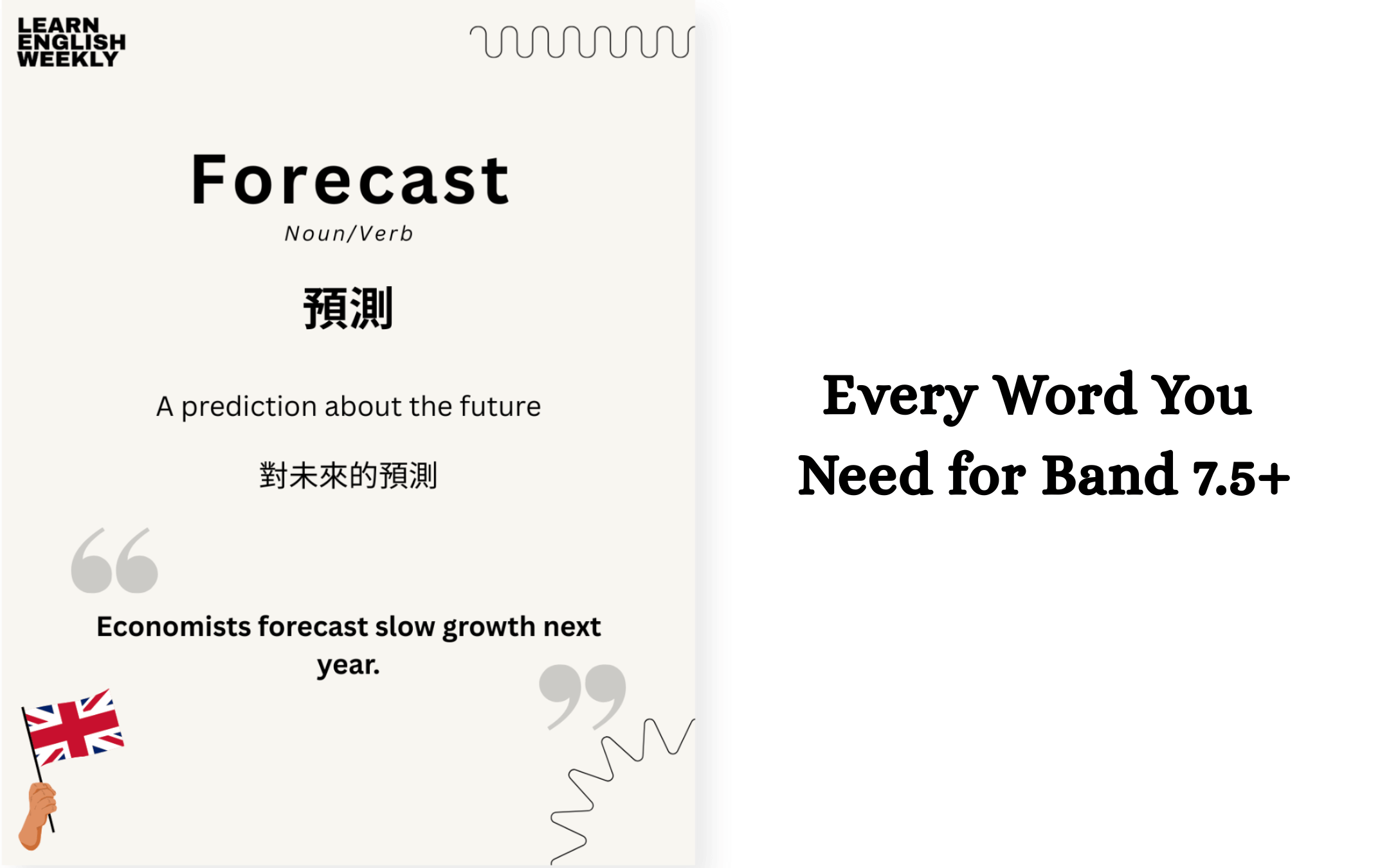
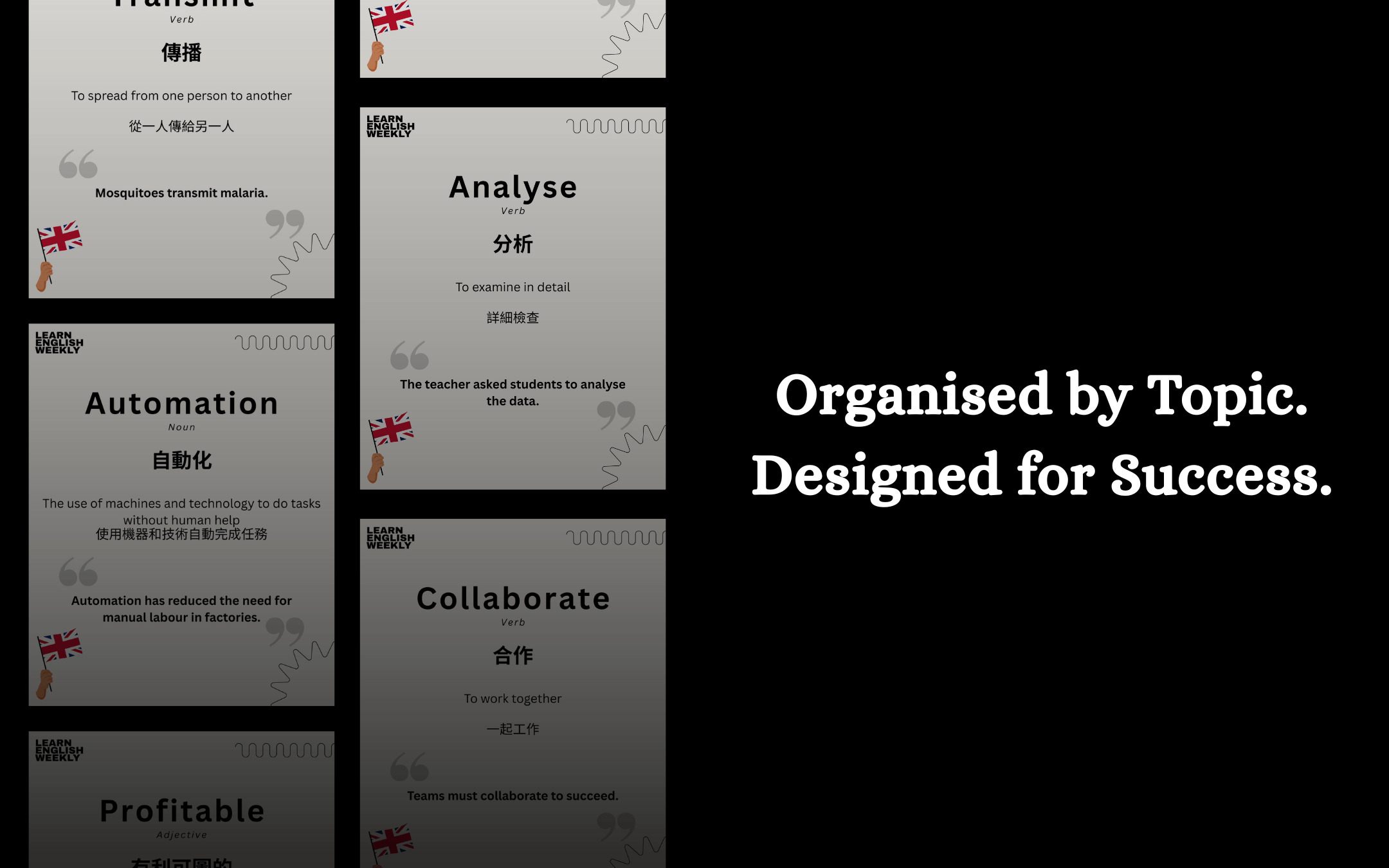
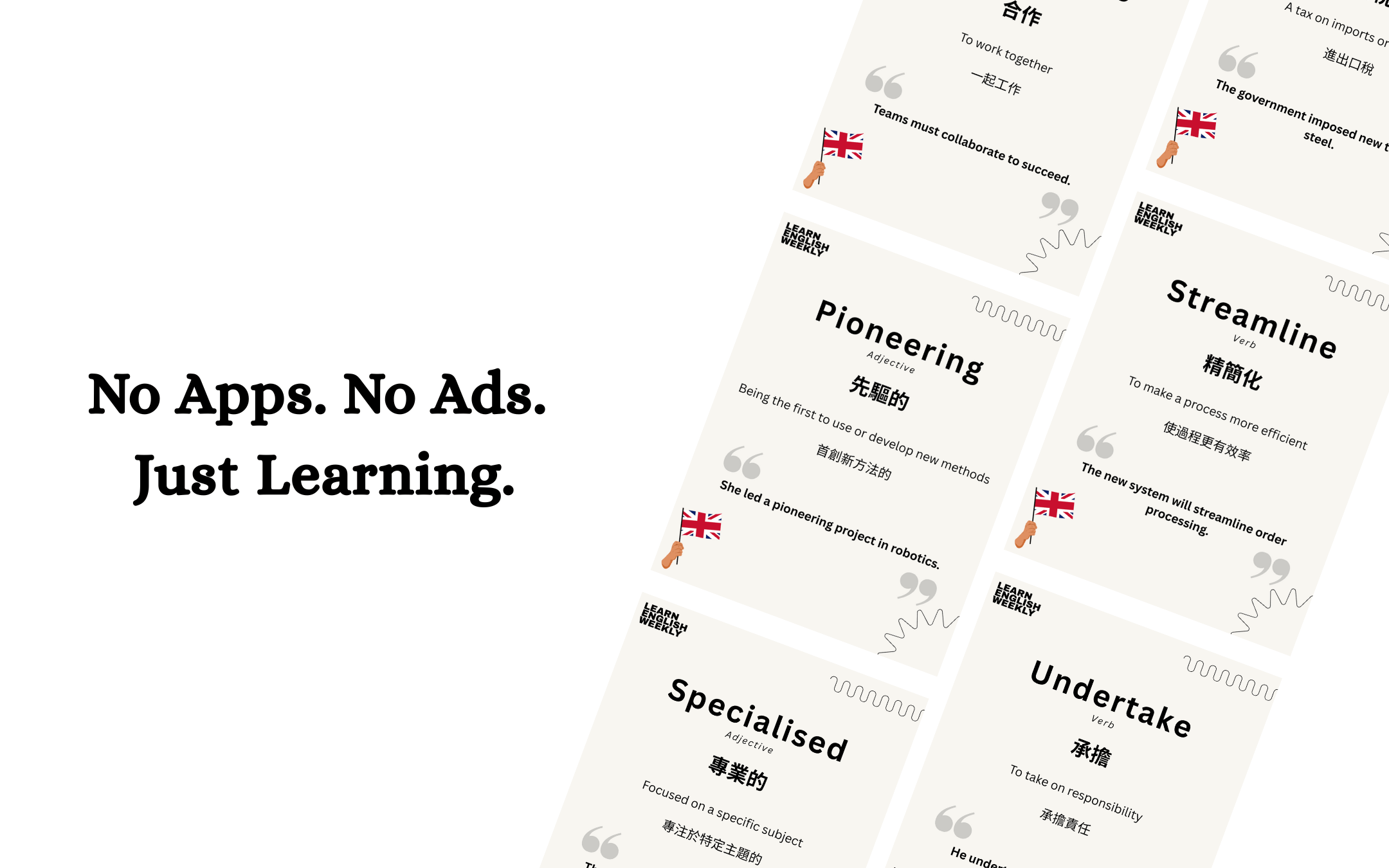
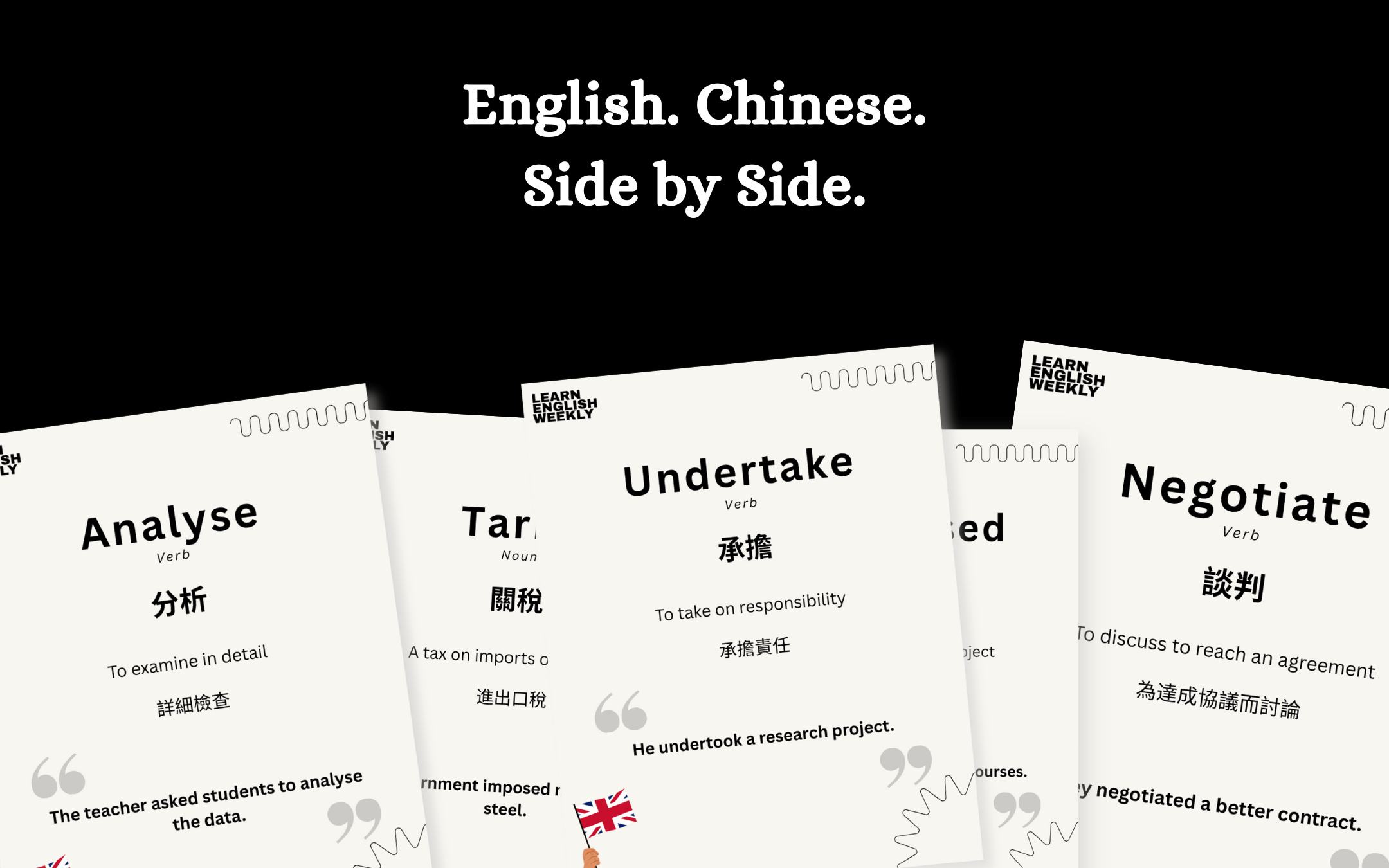
English + Traditional Chinese flashcards with real IELTS example sentences. Remember longer + boost your score. 20 Topics Included.

Education & Learning
Work & Career
Business & Economy
Technology & Innovation
Health & Medicine
Environment & Sustainability
Society & Social Issues
Government & Politics
Crime & Law
Science & Research
Communication & Media
Travel & Tourism
Culture, Art & Literature
Family & Relationships
Psychology & Emotions
Housing & Architecture
Food & Nutrition
Sports & Recreation
Philosophy & Religion
Miscellaneous Vocabulary



Erasmus Schröder, Germany
"This pack changed how I study IELTS vocab. I understand how to use the words now, not just memorise them."

Roy Wilvin, Taiwan
"The bilingual translations make learning so much easier. It definitely helped me get to band 7.5 in two months."

Roei Bahalker, Israel
"Perfect for quick revision before the test. The layout is clear and practical. I use these and watch the social media content, learning more every week!"
In the digital lexicon of contemporary Indonesian Muslim youth, certain phrases evoke not just an image, but an entire lifestyle, a mood, and a generational identity. One such phrase is “Hijab Imut Kacamata Sepulang Ngaji,” often timestamped with the specific window of “05-09 Min” — five to nine minutes past the hour. At first glance, this string of words might seem like a random caption for a social media post. However, a deeper reading reveals it as a cultural artifact, a poetic snapshot of a young Muslim woman navigating the intersection of tradition, modesty, and modern self-expression. This essay argues that the phenomenon of the “cute hijab, glasses, after-recitation” aesthetic represents a new, authentic language of piety that is intimate, digitally performative, and defiantly ordinary. The Semiotics of the “Imut” (Cute) Hijab The word imut is pivotal. Unlike the more formal syar’i (strictly religious) hijab that fully envelopes the body, or the professional hijab karier worn in offices, the hijab imut is characterized by soft colors—pastel pinks, mint greens, or cream—often paired with playful pleats, a slightly looser drape, or a decorative brooch shaped like a flower or a cloud. This “cuteness” is not about seduction; it is about approachability and youthfulness. It deconstructes the heavy, sometimes somber, connotations of religious obligation. By choosing the imut aesthetic, the wearer signals that piety is not a burden but a cheerful, joyful part of her daily life. The hijab becomes an extension of her vibrant personality, not a suppression of it. The Kacamata (Glasses): A Lens of Intellect The inclusion of kacamata (glasses) adds a critical layer of intellectual dignity. In many visual cultures, glasses symbolize studiousness, introspection, and a no-nonsense attitude. When juxtaposed with the imut hijab, the glasses temper the “cute” with the “earnest.” They suggest that the woman has just returned from an activity of the mind—studying the Qur’an, memorizing hadith , or discussing fiqh . The glasses frame not just the eyes, but a worldview. They say, “I am not merely an ornament of faith; I am a thinker of faith.” In a society that sometimes pits modernity against religiosity, the glasses serve as a visual manifesto that one can be both intellectually sharp and spiritually devoted. “Sepulang Ngaji” (After Recitation): The Sacred in the Secular The temporal marker sepulang ngaji (after coming home from religious study) is the emotional core of the essay. It refers to the halah or pengajian — informal or semi-formal Quranic study circles that are a staple of Indonesian Muslim life. This phrase captures a specific, fleeting state of being: the post-ritual glow. It is the moment when the mind is still resonating with the verses of Surah Ar-Rahman, the lips still taste the sweetness of doa , but the body is now entering the domestic, relaxed space of home.
In the hyper-accelerated digital age, these four minutes represent a rare pocket of stillness. The act of capturing and sharing a selfie in this specific timeframe is a form of digital mindfulness. It says, “I am present in this moment. I am neither rushing to the next task nor doom-scrolling through yesterday’s news. I am here, in my hijab and glasses, fresh from God’s words.” For followers on platforms like Instagram or TikTok, seeing the “05-09” timestamp creates a sense of real-time intimacy, as if they are sitting in the same living room, sharing a cup of tea after a long day of spiritual labor. Critics from conservative circles might dismiss “Hijab Imut Kacamata Sepulang Ngaji” as a trivial trend, a commodification of faith for the sake of “likes.” However, such a view misses the profound shift occurring in contemporary Islamic practice. For many young women, this aesthetic is not a distraction from faith but an expression of it. It is a theology of the ordinary—a belief that God is present in the tired smile, in the askew hijab, in the foggy glasses, and in the quiet five minutes after a long day of learning. Hijab Imut Kacamata Sepulang Ngaji05-09 Min
By celebrating the imut , the kacamata , and the 05-09 min , these women dismantle the false binary between the sacred and the profane. They prove that one can be cute and committed, intellectual and faithful, digital and devout. In a world that demands women to choose between being a “good Muslim” and a “modern individual,” the sepulang ngaji selfie offers a third space: one where the soul is fresh from the divine, and the face, framed by soft cloth and glass, smiles back at the camera—not in defiance, but in sincere, quiet contentment. In the digital lexicon of contemporary Indonesian Muslim
This is not the polished, studio-lit hijab of an influencer. This is the slightly askew hijab, the tired but content eyes, the glasses that have slid down the nose from hours of bending over a mushaf . It is raw, unfiltered, and therefore, profoundly authentic. By posting a selfie in this state, the young woman is reclaiming the “messy” as beautiful. She is saying that holiness is not found in perfection, but in the sincere effort of learning. The timestamp “05-09 Min” is the most enigmatic and modern component. It refers to the minutes immediately following the hour (e.g., 7:05 to 7:09 PM), likely right after the Maghrib or Isya prayer, which often follows ngaji sessions. This five-minute window is a liminal space—too late for formal duties, too early for sleep. It is a moment of transition and rest . However, a deeper reading reveals it as a

Hi, I’m Jordan, founder of Learn English Weekly.
I’m a TEFL-qualified English teacher with over 7 years of tutoring experience, and I’ve helped hundreds of students achieve IELTS Band 7+ and beyond.
This flashcard pack was designed from real IELTS material and classroom-tested methods that actually work.
Want to talk? You can get in touch here.

Motheeb Akeel, Pakistan
"Each topic is so well organised. I focused on ‘Work and Career’ and could actually use those words in my speaking test. Totally worth it."

Andres Jiménez, Chile
"These flashcards make it so easy to study little by little every day. Highly recommended. ¡Gracias! 🙏"

Shao Hsuan Peng, Taiwan
"I love that everything is explained in both English and Traditional Chinese, perfect for quick understanding. I need to use these words every day at work!"
Take your learning further with these popular English study packs.
Join the community for free resources and other learning opportunities.
No spam — only valuable English learning content.