×

Dipercaya oleh 500,000+ Bisnis
dari 100+ Negara



iREAP POS PRO


iREAP POS LITE
Kenali aktivitas toko dalam genggaman jari anda.



Laporan & Analitik, Realtime, Kapan Saja, Darimana Saja
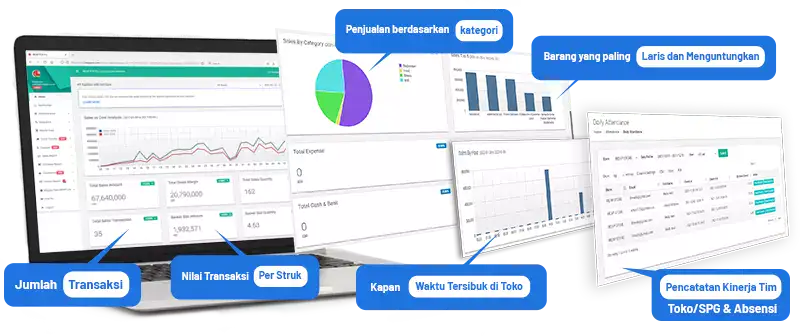
Akses ke laporan konsolidasi untuk seluruh toko di Web Dashboard kapanpun dan dimanapun.
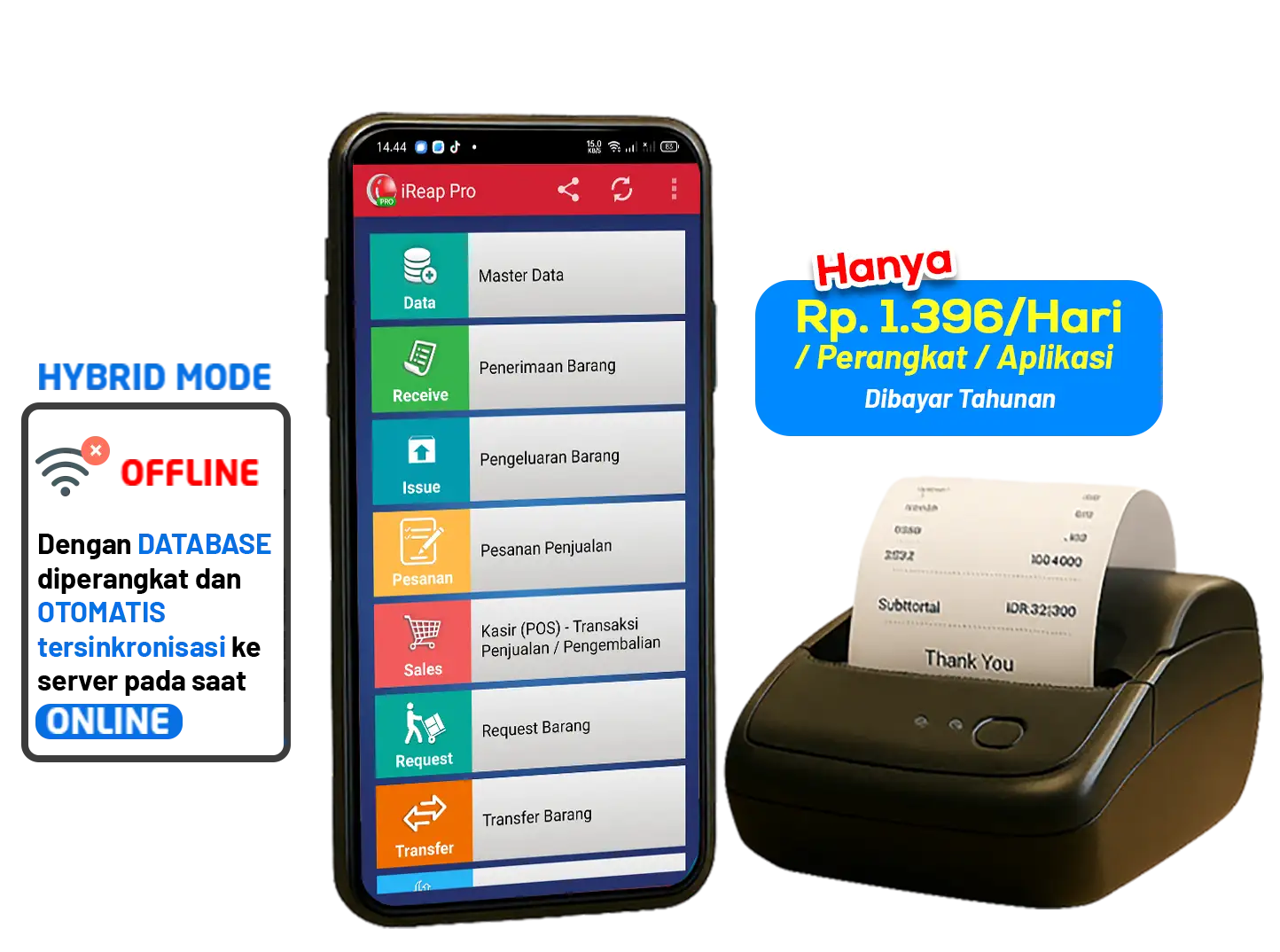
Dapat berjalan secara OFFLINE pada saat koneksi internet tidak tersedia
Semua Transaksi, Penerimaan Barang, Penjualan eceran, Pengeluaran barang terkonsolidasi dengan cloud ketika koneksi internet tersedia. Jika Koneksi internet tidak tersedia, transaksi akan tersimpan sementara dan otomatis disinkronisasi ketika Internet terkoneksi sehingga tidak ada kendala bisnis/ ✔ Extremely readable for beginners

Data Toko, User, Produk, Pelanggan, Pemasok, Harga akan secara otomatis tersinkronisasi dari dashboard Web dan Aplikasi Mobile

QRIS untuk transaksi E-Money & otomatis rekonsiliasi A standout feature is the “Code Corner” in each chapter

Mengatur toko anda dimanapun dan kapanpun!
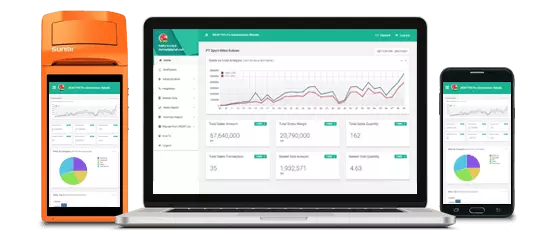
Daftar Perusahaan /Badan usaha anda, Toko dan Administrator dalam 5 Langkah Mudah
Mengatur Kategori Barang, Pemasok, Pelanggan, Master data Barang, dan Harga jual kapanpun dan dmanapun anda baik di Web ataupun Aplikasi Mobile. Mengatur dan Sinkronisasi otomatis ke seluruh perangkat Mobile POS
Penetapan user ke toko tertentu dengan hak akses yang sesuai
Admin, Manager, Supervisor, Cashier✔ Extremely readable for beginners. ✔ Strong code-to-concept linkage. ✔ Affordable (presumably for the local market).
A standout feature is the “Code Corner” in each chapter. Students don’t just learn what a filter does; they write a 5-line MATLAB script to see it happen. This B1 book emphasizes active learning over passive reading.
✘ May not cover advanced topics (Adaptive filters, Multirate DSP) in sufficient depth for graduate students. ✘ Limited international distribution (check regional publishers). Final Takeaway If you are an engineering student currently staring blankly at a waveform wondering what “processing” actually means, Tayyab Jan’s B1 book is your starting point. It turns the intimidating hum of white noise into a clear, learnable signal. Note: To purchase or verify the exact syllabus coverage, search for “Tayyab Jan DSP B1” on academic platforms or contact local technical bookstores.
Since details on a specific self-published or regional textbook can vary, this feature is structured as a based on the title keywords (B1 level, Digital Signal Processing, Author Tayyab Jan). You can adjust the specifics (course code, publisher) as needed. Unlocking the Digital World: A Look at the ‘B1 Book’ on DSP by Tayyab Jan In the rapidly evolving landscape of engineering education, finding a textbook that bridges the gap between complex mathematical theory and practical understanding is rare. Enter Tayyab Jan’s “B1 Book” on Digital Signal Processing (DSP) – a resource steadily gaining traction among undergraduate students. What is the ‘B1 Book’? For students navigating the often-intimidating world of signals and systems, “B1” is more than a shelf label; it represents a foundational level. This book is tailored for B1-level learners (typically 3rd or 4th semester engineering students) who have basic calculus and programming knowledge but are new to DSP concepts like convolution, Z-transforms, and filtering. Who is Tayyab Jan? Tayyab Jan is recognized in academic circles for a student-centric teaching philosophy. Unlike authors who prioritize theoretical rigor over readability, Jan focuses on de-jargonification . His writing style is conversational, breaking down complex algorithms into step-by-step logical progressions. He often incorporates local/regional examples, making global concepts feel accessible. Key Features of the Book 1. Simplified Mathematics The book avoids overwhelming the reader. Instead of starting with daunting Fourier equations, Jan introduces the concept of frequency analysis through graphical representations and flowcharts, followed by the math.
Apa yang Pengguna Kami Katakan Mengenai Aplikasi Kasir Android iREAP PRO
✔ Extremely readable for beginners. ✔ Strong code-to-concept linkage. ✔ Affordable (presumably for the local market).
A standout feature is the “Code Corner” in each chapter. Students don’t just learn what a filter does; they write a 5-line MATLAB script to see it happen. This B1 book emphasizes active learning over passive reading.
✘ May not cover advanced topics (Adaptive filters, Multirate DSP) in sufficient depth for graduate students. ✘ Limited international distribution (check regional publishers). Final Takeaway If you are an engineering student currently staring blankly at a waveform wondering what “processing” actually means, Tayyab Jan’s B1 book is your starting point. It turns the intimidating hum of white noise into a clear, learnable signal. Note: To purchase or verify the exact syllabus coverage, search for “Tayyab Jan DSP B1” on academic platforms or contact local technical bookstores.
Since details on a specific self-published or regional textbook can vary, this feature is structured as a based on the title keywords (B1 level, Digital Signal Processing, Author Tayyab Jan). You can adjust the specifics (course code, publisher) as needed. Unlocking the Digital World: A Look at the ‘B1 Book’ on DSP by Tayyab Jan In the rapidly evolving landscape of engineering education, finding a textbook that bridges the gap between complex mathematical theory and practical understanding is rare. Enter Tayyab Jan’s “B1 Book” on Digital Signal Processing (DSP) – a resource steadily gaining traction among undergraduate students. What is the ‘B1 Book’? For students navigating the often-intimidating world of signals and systems, “B1” is more than a shelf label; it represents a foundational level. This book is tailored for B1-level learners (typically 3rd or 4th semester engineering students) who have basic calculus and programming knowledge but are new to DSP concepts like convolution, Z-transforms, and filtering. Who is Tayyab Jan? Tayyab Jan is recognized in academic circles for a student-centric teaching philosophy. Unlike authors who prioritize theoretical rigor over readability, Jan focuses on de-jargonification . His writing style is conversational, breaking down complex algorithms into step-by-step logical progressions. He often incorporates local/regional examples, making global concepts feel accessible. Key Features of the Book 1. Simplified Mathematics The book avoids overwhelming the reader. Instead of starting with daunting Fourier equations, Jan introduces the concept of frequency analysis through graphical representations and flowcharts, followed by the math.

Tim kami dapat dihubungi dari Senin sd Jumat , dari pukul 8:30am sampai 5:30pm, GMT+7 time